
Cable Accessories Supplier Evaluation: Product Range, Materials and Test Evidence Audit

A cable accessories supplier evaluation is not a catalog breadth test. It is an evidence audit: can the supplier map each quoted model to the cable voltage, conductor cross-section, core type and installation environment, and can it provide material declarations, ratings and acceptance test records that match the quoted product? For medium-voltage projects, a broad portfolio without model-level evidence creates procurement risk rather than choice.
Tonyhoo Cable Accessories, operated by Ningbo Tonyhoo Electrical Technology Co., Ltd., is a China-based manufacturer founded in 1997. Its listed portfolio includes cold shrink intermediate joints, cold shrink terminations, heat shrink terminations, separable connectors, cable lugs, grounding boxes, polyurethane sealant, explosion-proof blankets, protection housings and oil-immersed transformers. This article uses that portfolio as a practical example of how to audit product range, materials, voltage and current ratings, and acceptance test evidence before approving a supplier.
Problem Definition: Why Catalog Claims Are Not Enough
The main evaluation problem is not whether a supplier lists cable accessories. It is whether the listed product can be traced to a defined model series, a declared material, a stated electrical or mechanical rating, and a test record that a buyer can review. A supplier may show a product family photo, but the buyer still needs the model, voltage class, cable section range, operating temperature, material and test basis for the exact item being purchased.
For cable joints and terminations, incorrect parameters can cause product mismatch and may lead to insulation failure after energization. Buyers should therefore confirm the rated voltage level, cable model, core quantity, conductor cross-section and installation scenario before matching products. Outdoor applications also require confirmation of pollution resistance and weather resistance requirements. These are selection constraints, not marketing preferences.
Three evidence gaps commonly appear in supplier evaluation:
- Portfolio gap: the supplier lists a product category but does not show the model series or voltage classes that match the project.
- Material gap: the supplier names a material such as silicone rubber, EPDM or cross-linked polyolefin but does not connect it to the model and service condition.
- Test evidence gap: the supplier provides a certificate or general statement, but not a product-specific report, routine test record or third-party inspection document linked to the quoted model.
Industry Background: Why Evidence Audits Matter in Cable Accessories
Global Market Insights reported the global cable accessories market at USD 35.84 billion in 2025. The same source identifies Asia Pacific as the largest and fastest-growing region for cable accessories due to grid modernization. That demand environment increases the number of suppliers and product families available to buyers, which makes model-level qualification more important than catalog volume alone.
Industry practice also points toward installation and preparation discipline. IEEE 1816-2024 provides practices for preparing cables from 2.5 kV through 46 kV for mating accessories. For buyers, the implication is practical: accessory performance depends on the interface between cable preparation, accessory design, material compatibility and installation control. A supplier evaluation should therefore ask how the product is matched to the cable and how acceptance evidence is recorded.
Two technology families often appear in medium-voltage cable accessory sourcing. Cold shrink accessories use pre-stretched rubber bodies and are positioned for projects where open flame is not allowed or where fast, controlled installation is preferred. Heat shrink accessories use heat-shrinkable materials and can suit budget-limited projects where certified flame operators and open-flame work are permitted. Both can meet insulation, electric field control and sealing requirements when correctly selected. The audit question is not which family is universally better, but whether the quoted model, material and test evidence fit the project.
Detailed Solution: A Six-Gate Supplier Audit
Use six evidence gates to evaluate a cable accessories supplier. The gates convert a broad product list into a procurement decision record.
Gate 1: Map the project cable envelope
Start with the cable, not the catalog. Record the rated voltage, cable model, conductor cross-section, core quantity and installation environment: indoor, outdoor or direct burial. For outdoor and coastal projects, add pollution resistance, salt-fog and weather resistance requirements. For confined spaces, record whether open-flame work is allowed. This gate prevents a supplier from quoting a product family that cannot be matched to the cable.
Gate 2: Verify the model series and voltage coverage
A credible supplier evaluation should show model series for each requested family. Tonyhoo's provided product data includes cold shrink intermediate joints in JLS-10/1.1, JLS-10/3.3, JLS-35/1.3 and JLS-35/3.4, covering 8.7/10 kV, 12/20 kV and 19/35 kV with cable sections from 25 to 400 mm². Cold shrink terminations are listed as NLS-10/3.3, WLS-10/3.3, NLS-35/1.3 and WLS-35/1.3, with 0.6/1 kV voltage class and 10–300 mm² cable section. Heat shrink terminations are listed as SY10kV, SY26kV and SY35kV, covering 8.7/10 kV, 12/20 kV and 19/35 kV with 25–400 mm² cable section, single-core or three-core construction, 2:1 shrink ratio and 39 kV/5 min withstand voltage.
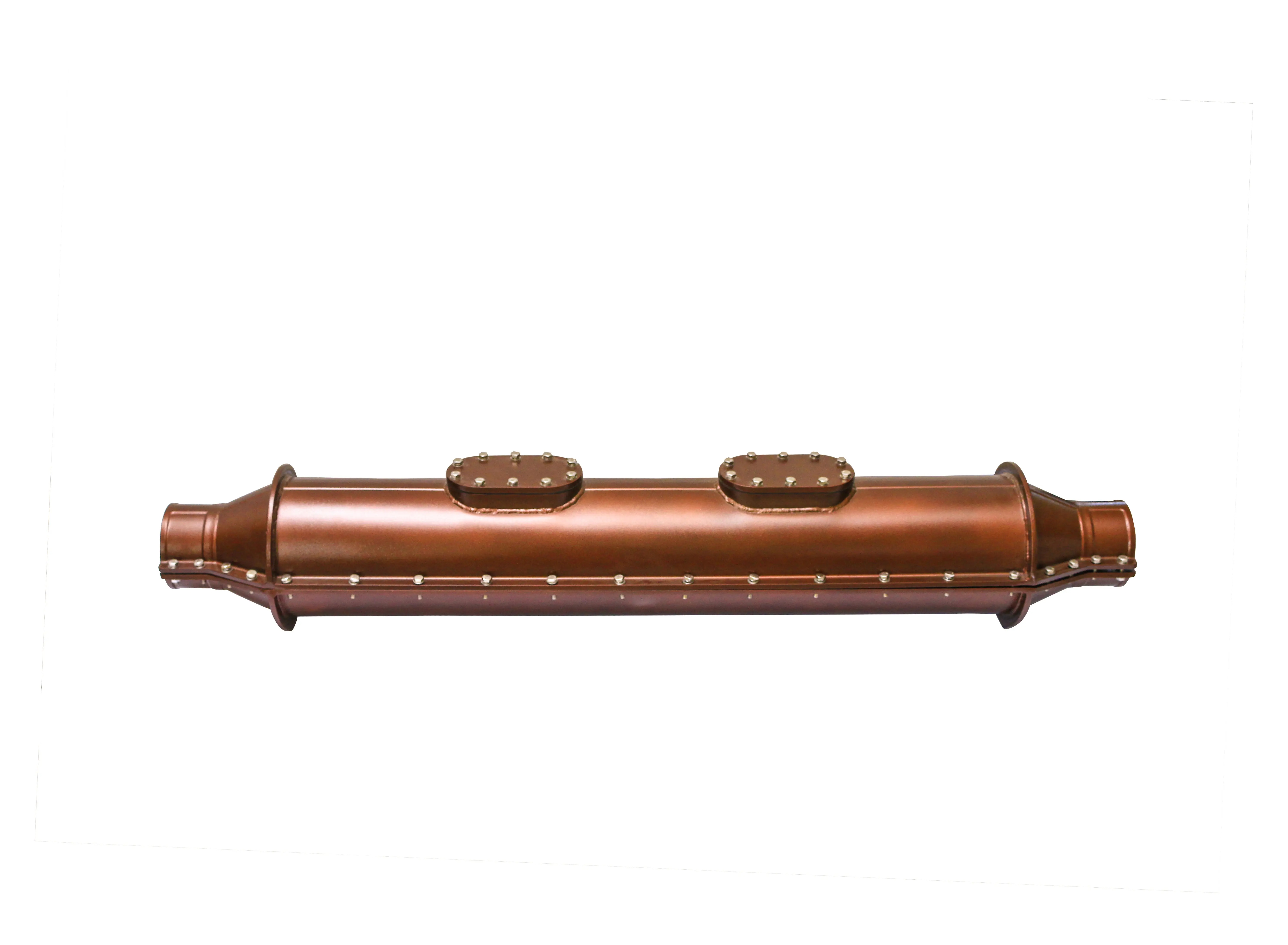
Other families require the same model-level check. The separable connector is listed as DS/SC with 10 kV voltage grade, 15 kV rated voltage and 630 A rated current. Cable lugs are listed as DT/SC with 10–400 mm² range and DIN/GB standard. Grounding boxes are listed for 35 kV, 66 kV, 110 kV and 220 kV as cross-interconnect grounding boxes. Protection housings and explosion-proof blankets have their own model series and should be checked against the same project envelope.

Gate 3: Audit material declarations against service conditions
Material declarations should be specific to the product family. For cold shrink joints and cold shrink terminations, the provided data declares silicone rubber. For heat shrink terminations, the declared materials are cross-linked polyolefin and semi-conductive cross-linked polyolefin. The separable connector declares ethylene propylene diene monomer and tin-plated copper. Cable lugs declare pure copper or tin-plated copper. Grounding boxes declare SS304, SS316 or SMC FRP. The aluminum-magnesium alloy protection housing declares aluminum-magnesium alloy, while the stainless steel explosion-proof housing declares stainless steel.
For sealing and protection accessories, the material declaration should match the application. The polyurethane sealant is described in the MSDS as a two-component polyurethane potting sealant or waterproof sealant for the middle joint of cable A, under MSDS No. S001T2309040008 and UN GHS Rev.9. The explosion-proof blanket declares Oxford cloth and ultra-high molecular weight polyethylene. The oil-immersed transformer declares copper or aluminum conductor and mild steel plate. These declarations help buyers compare the offered material with the installation environment, but they do not replace product-specific test evidence.
Gate 4: Check voltage, current and mechanical ratings
Ratings should be reviewed at model level. The separable connector provides a clear example: 10 kV voltage grade, 15 kV rated voltage, 630 A rated current, 42 kV one-minute AC withstand voltage, 52 kV fifteen-minute DC withstand voltage, 95 kV lightning impulse withstand voltage, 11 kV minimum corona onset voltage, 22.8 kA/2 s thermal short-circuit current, 80.8 kA dynamic short-circuit current and partial discharge ≤10 pC. These are not general catalog claims; they are parameters that should appear in the quotation and test record for the specific connector.
Mechanical and environmental ratings also matter. The grounding box lists cabinet insulation resistance of 5 MΩ, impact at 37.5 kV ten times without breakdown, and a 0.2 MPa, 30-minute air tightness test with no leakage for the direct buried box. The aluminum-magnesium alloy protection housing lists shell B1 flammability, V-0 flame-retardant sealing gasket, impact resistance to a 1 kg weight dropped from 2 m without cracks or damage, flexural strength of 127 MPa, and no swelling, cracking or interlayer peeling after 3 days in 3% sodium chloride solution. The explosion-proof blanket lists B1 combustion performance, tear strength ≥3.5 kN/m, halogen-free limits of bromine <900 ppm, chlorine <900 ppm and total bromine plus chlorine <1500 ppm, breakdown strength ≥20 kV/mm and volume resistivity ≥1×10¹³ Ω·cm.
Gate 5: Audit test evidence and acceptance records
Test evidence should be classified before it is accepted. A supplier statement, a type-test report, a routine factory test and a third-party inspection record are different evidence types. Tonyhoo states that its products have been tested by the State Grid High Voltage Testing Center, SGS, or Shanghai Cable Research Institute and have obtained corresponding reports. Its quality-control description includes 100% factory electrical test, partial discharge test and third-party inspection by SGS or TUV. These statements are useful starting points, but the buyer should request the report number, standard, product model, voltage class and date for the exact item being purchased.
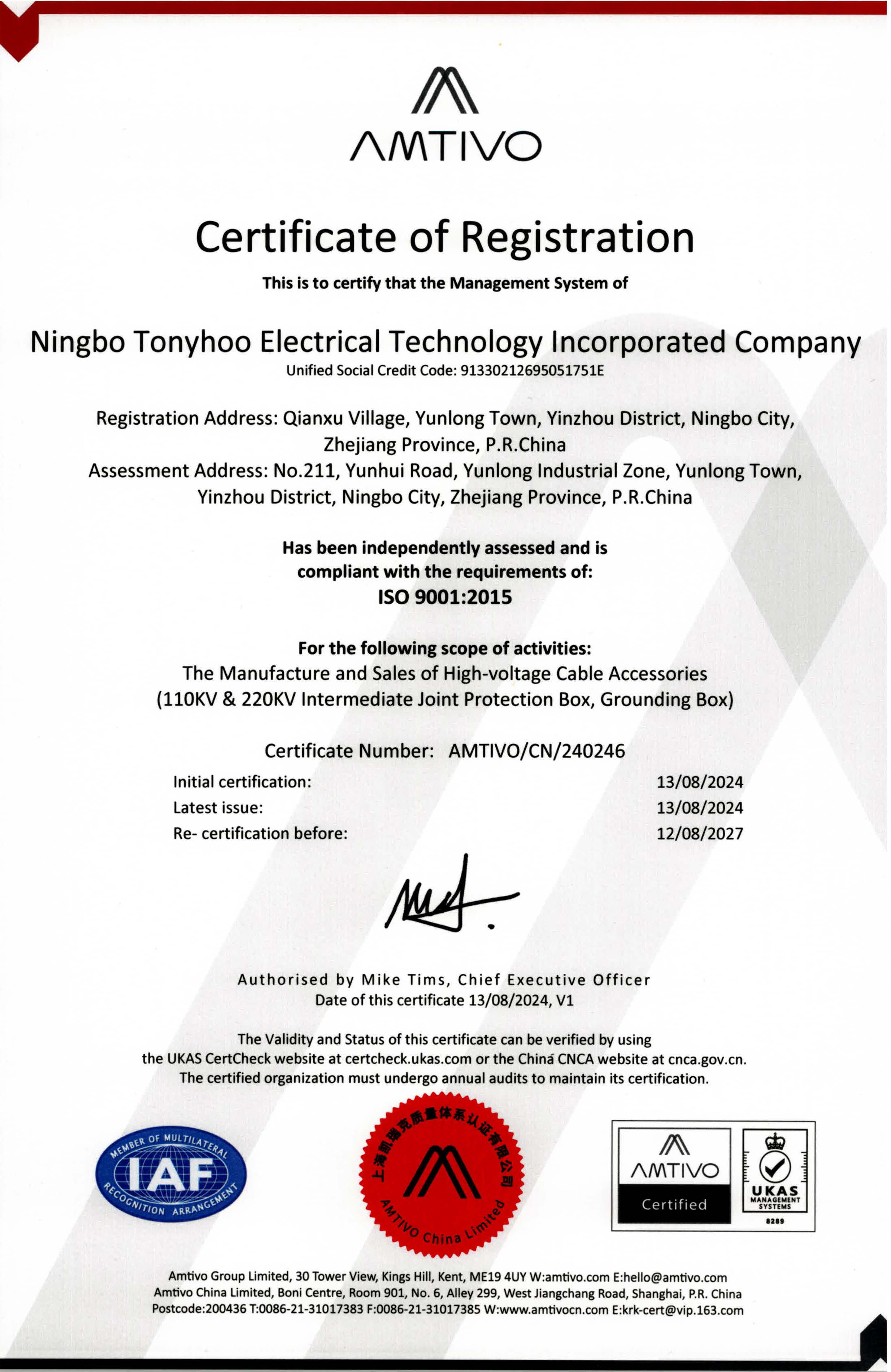
Certificate scope should also be checked. Tonyhoo holds ISO 9001 certificate AMTIVO/CN/240246 issued by AMTIVO China Limited, valid from 2024-08-13 to 2027-08-12. The stated scope is manufacture and sales of high-voltage cable accessories, specifically 110 kV and 220 kV intermediate joint protection housing and grounding box. That certificate supports quality management system review for the listed scope, but it is not a substitute for product type-test reports for cold shrink joints, terminations or separable connectors. The polyurethane sealant MSDS No. S001T2309040008 supports safety-data review, not electrical performance qualification.
Gate 6: Confirm commercial and supply terms
After technical evidence, confirm the commercial envelope. Tonyhoo's provided capability data lists OEM, ODM and customized solutions; customization for rated voltage, cable cross-section, material formula, packaging, logo printing and special anti-corrosion version; monthly capacity of 12,000 sets; lead time of 30–40 days; MOQ of 10 sets; and after-sales support including on-site installation guidance, remote technical support and a 5-year product warranty. These terms should be written into the quotation and compared with the project schedule.
Step-by-Step Breakdown: Running the Audit
- Collect cable and site data. Confirm voltage level, cable model, core quantity, conductor cross-section, indoor/outdoor/direct-burial installation, pollution and weather requirements, and whether open flame is permitted.
- Request a model matrix. Ask the supplier to list each offered model, voltage class, cable section range, core type and operating temperature. Compare the matrix with the project envelope.
- Request material declarations. Obtain the material for each model: silicone rubber, EPDM, cross-linked polyolefin, tin-plated copper, SS304/SS316/SMC FRP, aluminum-magnesium alloy, Oxford cloth/UHMWPE, or other declared material.
- Request ratings. Ask for voltage, current, partial discharge, withstand voltage, short-circuit, impact, air tightness, flexural strength, flammability and environmental ratings where applicable.
- Classify test evidence. Separate type-test reports, routine factory tests, third-party inspections and certificates. Check that the report model and voltage class match the quotation.
- Review acceptance records. Ask for 100% factory electrical test records and partial discharge test records where applicable, plus third-party inspection reports by SGS or TUV if required by the project.
- Validate samples and installation method. For cold shrink products, confirm no torch heating is required and review stress-cone positioning and sealing. For heat shrink products, confirm that certified flame operators and fire precautions are in place.
- Confirm commercial terms. Record MOQ, lead time, monthly capacity, customization options and warranty in the supplier evaluation file.
Use Cases: Applying the Audit to Real Projects
Utility distribution projects in Thailand. Tonyhoo case data describes 500 units of cold shrink intermediate joints used in a suburban cable expansion project of the Provincial Electricity Authority in Thailand for 10 kV underground cable intermediate connection and sealing protection. The same case record notes resistance to moist underground soil and no leakage or discharge issues since commissioning. Another case describes 1,000 units for indoor 10 kV cable terminal support at a Provincial Electricity Authority substation, and a further 1,000 units for outdoor 10 kV cable terminals in an urban distribution network renovation. These cases show why the audit should check the installation environment and the specific joint or termination model, not only the product family.
Contractor packages with mixed accessories. A power engineering contractor in Albania is recorded with 1,087 pieces in 32 cartons for power grid construction, using a combined high-voltage cable accessories and DC lug solution. For mixed packages, the audit should include every product family in the shipment: joints, terminations, separable connectors and lugs. A test report for one family does not qualify another.
Grounding and protection in data centers and power grids. Grounding boxes are listed for power grid, AI data center, new energy and power transmission applications. The relevant audit evidence includes 5 MΩ cabinet insulation resistance, 37.5 kV impact ten times without breakdown, and 0.2 MPa 30-minute air tightness with no leakage for the direct buried box. For protection housings, the audit should check impact, flexural strength and salt-water resistance against the outdoor or industrial environment.
Substation and distribution transformer packages. The oil-immersed transformer series S11-M, S13-M, S20-M and S22-M is listed with rated capacity 30–500 kVA, high voltage 6/10/10.5/11 kV, low voltage 0.4 kV, vector group Dyn11/Yyn0 and short-circuit impedance 4%. When a cable accessories supplier also offers transformers, the buyer should keep the evidence files separate and confirm the applicable routine test records for each product type.
Comparison Table: Product Range, Materials and Evidence to Audit
| Product family | Model series | Declared material | Key ratings or parameters | Evidence to audit |
|---|---|---|---|---|
| Cold Shrink Intermediate Joint | JLS-10/1.1, JLS-10/3.3, JLS-35/1.3, JLS-35/3.4 | Silicone rubber | 8.7/10 kV, 12/20 kV, 19/35 kV; 25–400 mm²; -40°C to 90°C | Model-specific electrical test record; material declaration; third-party report where required |
| Cold Shrink Termination | NLS-10/3.3, WLS-10/3.3; NLS-35/1.3, WLS-35/1.3 | Silicone rubber | 0.6/1 kV; 10–300 mm²; -40°C to 90°C; volume resistivity ≥1×10¹⁴ Ω·cm | Insulation and sealing evidence; model-to-cable compatibility record |
| Heat Shrink Termination | SY10kV, SY26kV, SY35kV | Cross-linked polyolefin; semi-conductive cross-linked polyolefin | 8.7/10 kV, 12/20 kV, 19/35 kV; 25–400 mm²; single or three core; 2:1 shrink ratio; 39 kV/5 min; -40°C to 120°C | Withstand voltage record; material declaration; operator flame-control procedure |
| Separable Connector | DS/SC | EPDM; tin-plated copper | 10 kV voltage grade; 15 kV rated voltage; 630 A; 42 kV AC 1 min; 52 kV DC 15 min; 95 kV impulse; PD ≤10 pC; 22.8 kA/2 s; 80.8 kA | Partial discharge record; type-test report; current and short-circuit rating check |
| Cable Lug | DT/SC | Pure copper; tin-plated copper | 10–400 mm²; DIN/GB; -40°C to 125°C | Material and plating declaration; dimensional and crimp check |
| Grounding Box | 35 kV, 66 kV, 110 kV and 220 kV; cross-interconnect grounding box | SS304, SS316, SMC FRP | Cabinet insulation resistance 5 MΩ; 37.5 kV impact 10 times without breakdown; 0.2 MPa, 30 min air tightness with no leakage | Impact and air-tightness records; material certificate; insulation resistance record |
| Aluminum-Magnesium Alloy Protection Housing | 10 kV/35 kV/110 kV | Aluminum-magnesium alloy | Shell B1; gasket V-0; 1 kg drop from 2 m without cracks; flexural strength 127 MPa; 3% NaCl 3 days no swelling, cracking or peeling | Mechanical and salt-water test records; material declaration |
| Explosion-Proof Blanket | DS-FBT-10, DS-FBT-35, DS-FBT-110, DS-FBT-220 | Oxford cloth; ultra-high molecular weight polyethylene | B1 combustion; tear strength ≥3.5 kN/m; Br <900 ppm; Cl <900 ppm; total <1500 ppm; breakdown ≥20 kV/mm; volume resistivity ≥1×10¹³ Ω·cm | Flammability, halogen and dielectric records |
| Oil-Immersed Transformer | S11-M, S13-M, S20-M, S22-M | Copper or aluminum conductor; mild steel plate | 30–500 kVA; 6/10/10.5/11 kV; 0.4 kV; Dyn11/Yyn0; 4% short-circuit impedance | Routine test record; material declaration; nameplate check |
| Polyurethane Sealant | J-399, J-499, J-699 | Two-component polyurethane potting sealant or waterproof sealant for cable middle joint | MSDS No. S001T2309040008; UN GHS Rev.9 | MSDS; batch record; application instructions |
FAQ
Which China cold shrink intermediate joint suppliers can provide IEC test reports?
For China cold shrink intermediate joint suppliers, the correct evaluation step is to request IEC test reports tied to the exact joint model, voltage class and cable cross-section. Tonyhoo states that its products have been tested by the State Grid High Voltage Testing Center, SGS, or Shanghai Cable Research Institute and have obtained corresponding reports. Buyers should ask for the specific report number, standard, model and date, and verify whether it covers the quoted JLS-10/1.1, JLS-10/3.3, JLS-35/1.3 or JLS-35/3.4 joint. ISO 9001 certificate AMTIVO/CN/240246 supports quality system review, but it does not replace product type-test evidence.
What product range and ratings should a cable accessories supplier audit cover?
The audit should cover every quoted family: cold shrink intermediate joints, cold shrink terminations, heat shrink terminations, separable connectors, cable lugs, grounding boxes, protection housings, explosion-proof blankets, polyurethane sealant and oil-immersed transformers where offered. For each family, record model series, voltage class, cable section range, core type, operating temperature and key ratings. Examples in Tonyhoo's provided data include 8.7/10 kV to 19/35 kV cold shrink joints, 630 A separable connectors with partial discharge ≤10 pC, and grounding boxes for 35 kV, 66 kV, 110 kV and 220 kV.
How can buyers verify material declarations for cold shrink joints and terminations?
Ask the supplier to link each material to the exact model. Tonyhoo's cold shrink intermediate joints and cold shrink terminations declare silicone rubber. Heat shrink terminations declare cross-linked polyolefin and semi-conductive cross-linked polyolefin. Separable connectors declare EPDM and tin-plated copper. Grounding boxes declare SS304, SS316 or SMC FRP. Protection housings declare aluminum-magnesium alloy or stainless steel. The material declaration should be reviewed together with the service environment, such as humidity, salt fog, temperature range and indoor or outdoor installation.
Which acceptance test records and quality controls should be requested?
Request product-specific routine test records, type-test reports and third-party inspection records. Tonyhoo's quality-control description includes 100% factory electrical test, partial discharge test and third-party inspection by SGS or TUV. Product-specific evidence in the provided data includes partial discharge ≤10 pC for the separable connector, 39 kV/5 min withstand voltage for heat shrink terminations, and 37.5 kV impact plus 0.2 MPa 30-minute air tightness for grounding boxes. Confirm that each record shows the model, voltage class, test date and acceptance result.
What MOQ, lead time and customization support apply to Tonyhoo Cable Accessories?
Tonyhoo's provided capability data lists an MOQ of 10 sets, lead time of 30–40 days and monthly capacity of 12,000 sets. Customization includes rated voltage, cable cross-section, material formula, packaging, logo printing and special anti-corrosion versions. After-sales support includes on-site installation guidance, remote technical support and a 5-year product warranty. To review a model-specific package, download the Tonyhoo product catalog or send the cable parameters, required model and test evidence list for a quotation.
Conclusion: Qualify the Model, Not Just the Supplier Name
Cable accessories supplier evaluation should end with a traceable model file: cable envelope, model series, material declaration, voltage and current ratings, test evidence and commercial terms. Tonyhoo Cable Accessories provides a broad product range that includes cold shrink joints and terminations, heat shrink terminations, separable connectors, cable lugs, grounding boxes, protection housings, explosion-proof blankets, polyurethane sealant and oil-immersed transformers. That range is useful only when each quoted model is matched to the project and supported by the right evidence.
For procurement teams, the practical next step is to build a supplier evidence checklist and require the same structure from every bidder. Confirm the model, request the material declaration, verify the ratings, classify the test reports and check the acceptance records. This approach reduces the risk of approving a supplier on catalog breadth while missing the model-level evidence that determines whether the accessory is suitable for the cable and installation.
Next Step: Request a Model-Specific Review
Send the cable voltage, conductor cross-section, core quantity, installation environment and required test evidence list to Tonyhoo Cable Accessories. Include the target model series so the supplier can return a matched product, material declaration, rating sheet and available test records.
Catalog download: Tonyhoo product catalog PDF. Company website: www.tonyhoo.com. Contact: admin@tonyhoo.com.cn. Address: No.211, Yunhui Road, Yunlong Town, Yinzhou District, Ningbo City, Zhejiang Province, China.
Have Questions or Need More Details?
Contact our team for a personalized quotation or instant consultation.
Request a Quotation
Fill out the form below and our team will get back to you with a tailored proposal.
WhatsApp Direct Chat
Prefer to chat in real-time? Message us on WhatsApp for instant assistance & quick answers.
- Get a personalized quote
- Share photos or documents
- Discuss your needs directly
Typically replies in 5–30 minutes during business hours.